Where Is Your Business on the Workflow Journey? Five Levels and the Next Sensible Step
2026-10-07
Executive Summary
- Most leaders find it hard to say objectively what level their workflow is at. This article offers five levels, described by how a process actually runs, not by the technology in use: manual, digitized, rule-automated, context-aware, and governed AI-assisted.
- One diagnostic question is enough to start: “If the person running this process takes a week off, what happens?” The answer shows whether the process depends on a system or on one person.
- The scale applies per process, not to the whole company. A business sitting at several levels at once is normal.
- A higher level is not better for every process. The aim is to find the next economically sensible step for the most important process, not to push everything to level 5.
- At level 5, AI still does only two things: interpret input so rules can run, and prepare evidence so people can judge. Decision authority does not move to AI at any level.
Introduction
Ask an executive “what level is your workflow at?” and you usually get an answer in software: “We run an ERP”, “We have approval software”, “We are trying AI”. Those answers describe tools, not how the work gets done.
Two companies with the same ERP can be very different. In one, a special order is handled correctly because the coordinator remembers this customer has its own terms. In the other, the terms are recorded and the system reminds people at the right moment. Same software, different operating level.
So this article describes the levels by what happens in the process, and offers a diagnostic question that does not depend on technology.
The Diagnostic Question: the Owner Takes a Week Off

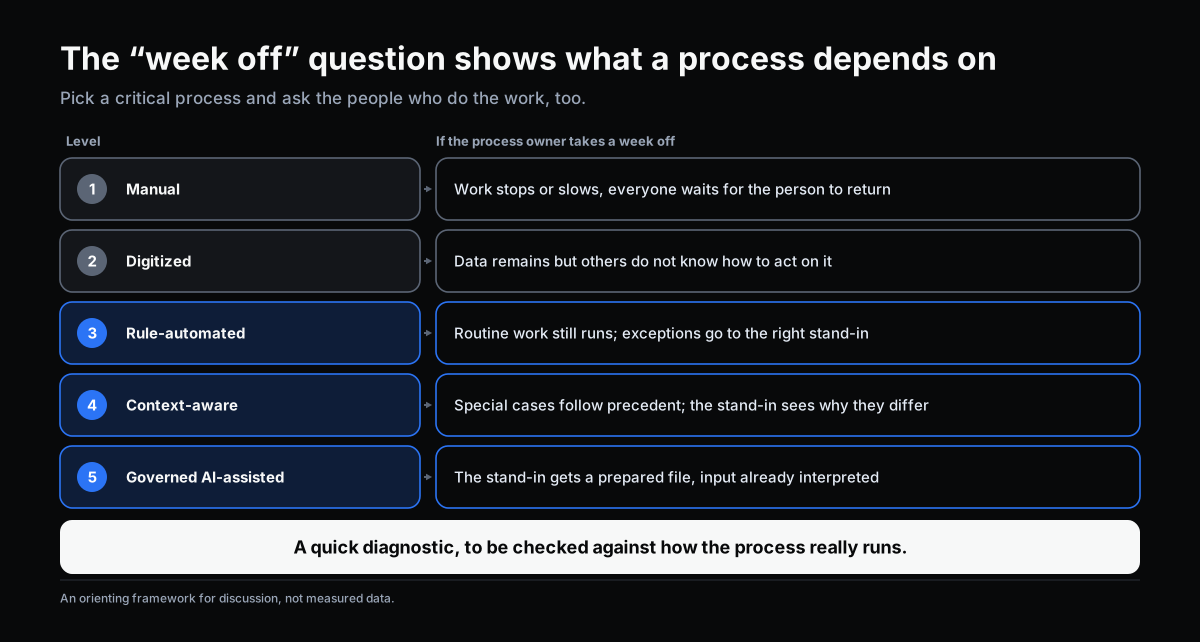
Pick a critical process — say order intake, batch release or complaint handling. Ask:
If the person running this process takes a week off, what happens?
- Work stops or slows, everyone waits for the person to return: the process is at level 1.
- The data is still there but others do not know how to act on it: level 2.
- Routine work still runs, and exceptions are routed to the right stand-in: level 3.
- Special cases are also handled by confirmed precedent, and the stand-in can see why this case differs: level 4.
- The stand-in receives a prepared file, with unstructured input already interpreted: level 5.
This is a quick diagnostic, not a measurement. It opens the right conversation, and should be checked against how the process really runs.
Five Levels at a Glance

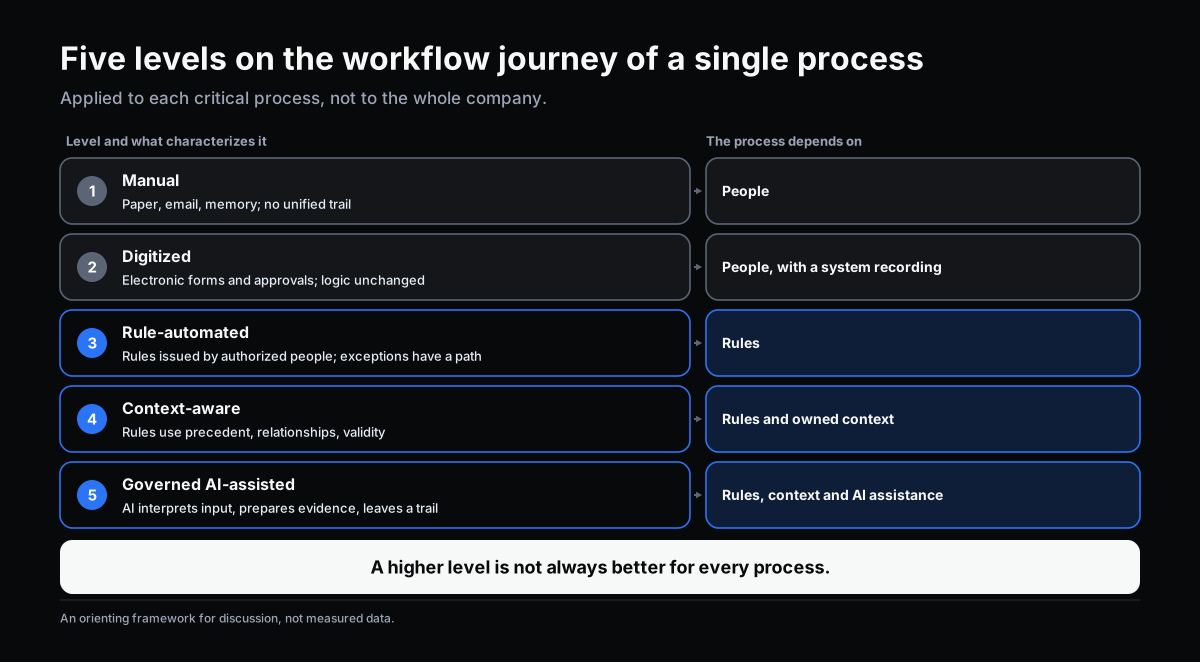
| Level | Name | What characterizes it | The process depends on |
|---|---|---|---|
| 1 | Manual | Paper, email, memory; no unified trail | People |
| 2 | Digitized | Electronic forms and approvals; processing logic unchanged | People, with a system recording |
| 3 | Rule-automated | Rules issued by authorized people; repetitive work runs itself; exceptions have a path | Rules |
| 4 | Context-aware | Rules use organizational context: precedent, relationships, validity | Rules and owned context |
| 5 | Governed AI-assisted | AI interprets input and prepares evidence, with identity, permissions and a trail | Rules, context and AI assistance |
This is OKELAS’s framework for discussion, not an industry standard. Familiar maturity models, such as the Software Engineering Institute’s CMM, also describe sequential stages. What differs here is that the question is asked at the process level, with a warning attached: moving up has a cost, and not every process is worth moving.
Level 1 · Manual
From the outside: paper files, email, messages; people remember the rules; hard to tell where a job stands.
Value: flexible, no system cost. For a process that rarely occurs, this can be a reasonable level.
Limits: dependent on people, hard to trace, hard to train new staff, hard to demonstrate to an ISO or GMP assessor.
The next step usually means: record the steps that truly happen, before choosing any tool.
Level 2 · Digitized
From the outside: electronic forms, approvals in software, records you can search.
Value: centralized data, a trail, fewer lost documents.
Limits: the processing logic still lives in people’s heads. The system has only moved paper onto a screen. If that person is away, others see the data but not the rules.
The next step usually means: take rules out of personal memory and write them as clear rules for repeating cases.
Level 3 · Rule-automated
From the outside: repetitive work runs on events; thresholds and conditions are issued by authorized people; exceptions have a path to the right person.
Value: speed, consistency, traceability, because every action has a rule that permits it.
Limits: rules handle only what has been written down. Special cases, like a customer with its own terms, tend to be pushed entirely into exceptions, and the handler cannot see why.
The next step usually means: bring the context experienced people still use into the process; see When a Workflow Knows the Organization’s Context.
Level 4 · Context-aware
From the outside: rules can refer to confirmed precedent, a customer’s own terms, the validity of an earlier decision. Context has an owner and an expiry, so it does not quietly go stale.
Value: special cases are handled consistently rather than depending on who is on duty. Experienced people’s knowledge becomes part of the process.
Limits: context takes effort to maintain. Context with no owner goes wrong quickly. Rules change only when an authorized person issues the change from confirmed precedent; they do not change on their own.
The next step usually means: deal with the unstructured input and file-gathering that still consume people’s time.
Level 5 · Governed AI-assisted
From the outside: AI does two things. It interprets unstructured input (emails, scans, notes) into a form rules can run on. It prepares evidence for an authorized person to review and judge. AI works as a participant with its own identity, permissions tied to the task and a traceable trail, as described in Delegating Workflow Steps to AI.
Value: less time spent re-reading, re-keying and gathering files. People concentrate on the part that needs judgment.
Limits: this level pays off only when levels 3 and 4 exist, because AI needs rules for its output to run on and context for its files to mean something. Decisions still belong to rules issued by authorized people, or to people. Actions run automatically only when a rule permits.
On agents: some steps at this level may use a narrow agent to prepare evidence, when the lookup sources vary by case. That is an option within level 5, with its own conditions, as Does Your Workflow Need an AI Agent? analyzes. It is not a higher level.
Why Five Levels and Not Six

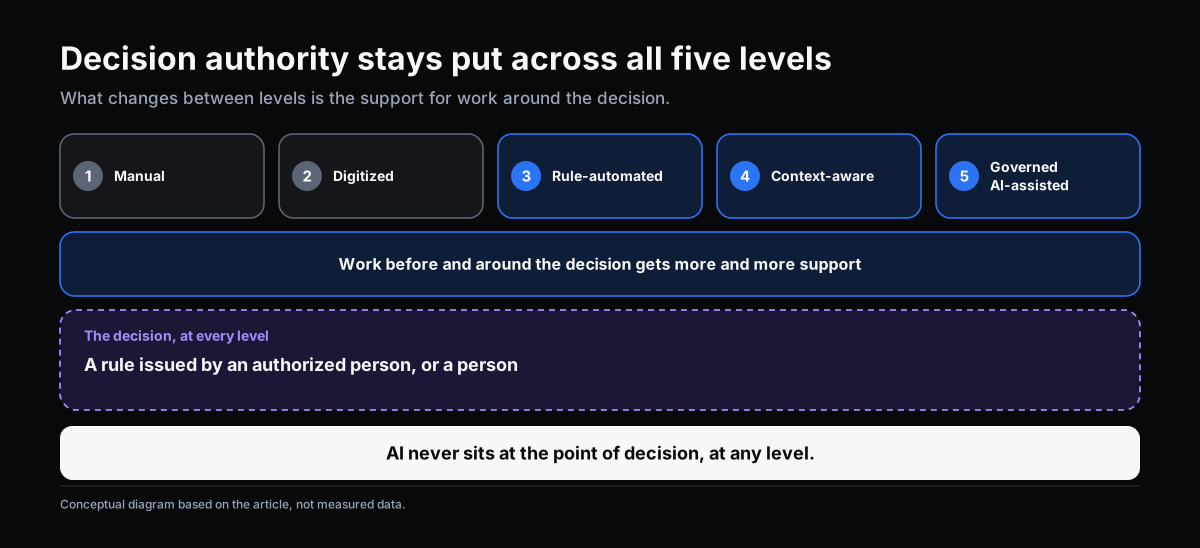
Some models make the “autonomous agent” the top level, as if a company advances when AI plans and executes by itself, or split “intelligent” and “agentic” into separate levels. This framework folds the AI part into one level, for two reasons.
First, operational progress is not measured by AI’s autonomy. A business runs better when processes are clear, rules have owners, context is maintained and AI does its proper job. An AI that decides does not make the process better; it blurs who decides.
Second, decision authority does not shift between levels. At every level, the decision belongs to a rule issued by an authorized person, or to a person. What changes between levels is how far the work before and around the decision is supported.
Three Notes on Using This Scale

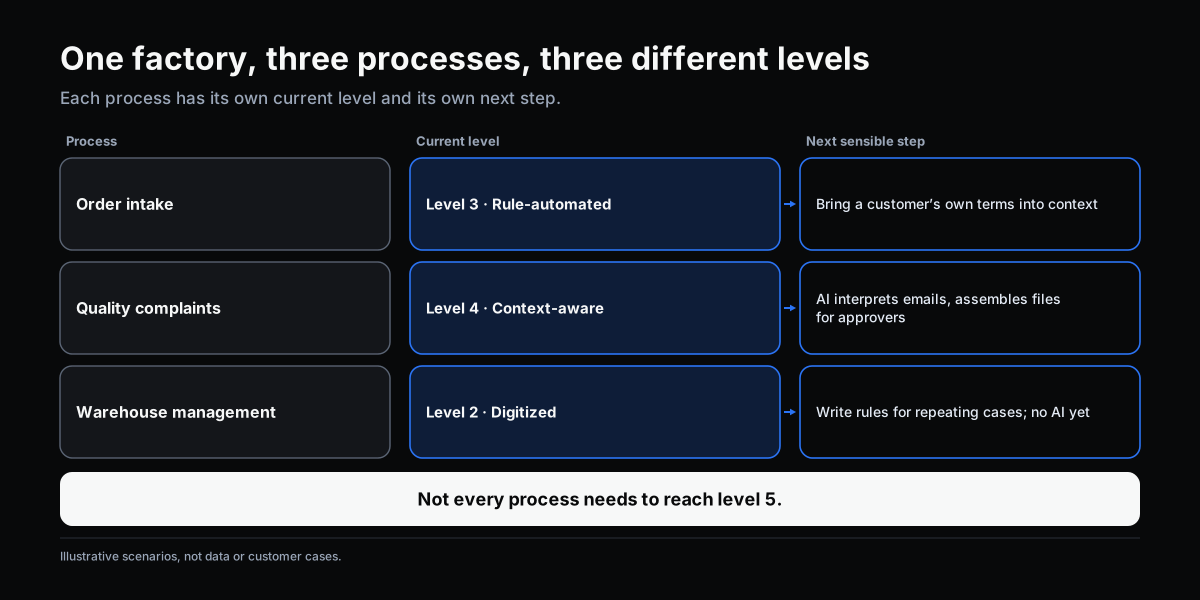
1. Use it per process, not for the whole company. A factory may have order intake at level 3, quality-complaint handling at level 4, warehouse management at level 2, and a few rare tasks still at level 1. That is normal (an illustrative example, not a specific case). The useful question is which process is causing the most loss.
2. Go in sequence, but you need not go all the way. Skipping a level usually creates debt: putting AI on a process with no clear rules only makes ambiguity run faster. But “in sequence” does not mean reaching level 5. For many processes, level 3 is a sensible stopping point.
3. Choose the economically sensible next step. For each critical process, ask what the next level would save (handling time, errors, dependence on one person, audit preparation effort), what it would cost, and what risk remains if you do nothing. If the answer is unclear, that is a signal not to move up yet.
Where to Start
- Pick three to five processes that matter most for operations or compliance.
- Ask the “week off” question for each, and ask the people who do the work, not only their manager.
- Look at reality: take a few recent cases and follow the steps that truly happened, not the process on paper.
- Identify each process’s current level and the main bottleneck to the next.
- Choose one process and one next step with the clearest benefit. Do it well before expanding.
Self-Check
- For your most important process, if its owner takes a week off, what happens?
- Where do the processing rules live: in people’s heads, in documents, or in rules issued by an authorized person?
- Are special cases handled by confirmed precedent, or by whoever is on duty?
- Does the context the process uses have an owner and an expiry?
- If AI is used, is it interpreting input or preparing evidence, or has it been placed at the point of decision?
- Does moving this process up one level have a clear economic benefit?
If question 5 shows AI sitting at the point of decision, revisit the boundary before expanding.
Conclusion
The workflow journey is not a race to the top level. It is a matter of looking at each critical process, knowing whether it depends on people, rules or context, and choosing the next step worth taking. Five levels, from manual to governed AI-assisted, help name where you are. Whether to move up is an economic and governance question, not a technology one.
One thing stays fixed across all levels: decision authority belongs to rules issued by authorized people, or to people. AI helps with the work before and around the decision.
OKELAS’s Digitalization Readiness Assessment helps you identify which level each process is at and what the next bottleneck is.
Sources
- Paulk, M. C., Curtis, B., Chrissis, M. B., & Weber, C. V. (1993). Capability Maturity Model for Software, Version 1.1. Software Engineering Institute, Carnegie Mellon University. Cited as a reference for how maturity models describe sequential stages.
- Parasuraman, R., Sheridan, T. B., & Wickens, C. D. (2000). A model for types and levels of human interaction with automation. IEEE Transactions on Systems, Man, and Cybernetics – Part A, 30(3), 286–297.
- Anthropic (2024). Building effective agents. Distinguishes predefined workflows from agents.
The five-level framework and the diagnostic question are OKELAS’s viewpoint for discussion, not measured data or an industry standard.
Related Articles
- Does Your Workflow Need an AI Agent? Five Levels of AI Use and Four Questions to Pick the Right One
- Delegating Workflow Steps to AI: Think at the Task Level, Govern It as a Participant
- When a Workflow Knows the Organization’s Context: Maintained Knowledge, Decisions Still Made by People
- Automation and AI-Assisted Workflow: Two Different Things, Not Two Rungs on a Ladder
Does this describe your organization?
Does this sound familiar to your organization?