Organization Knowledge Operating System for Manufacturers
Your computer runs on an operating system. Your company runs on a few people's memory.
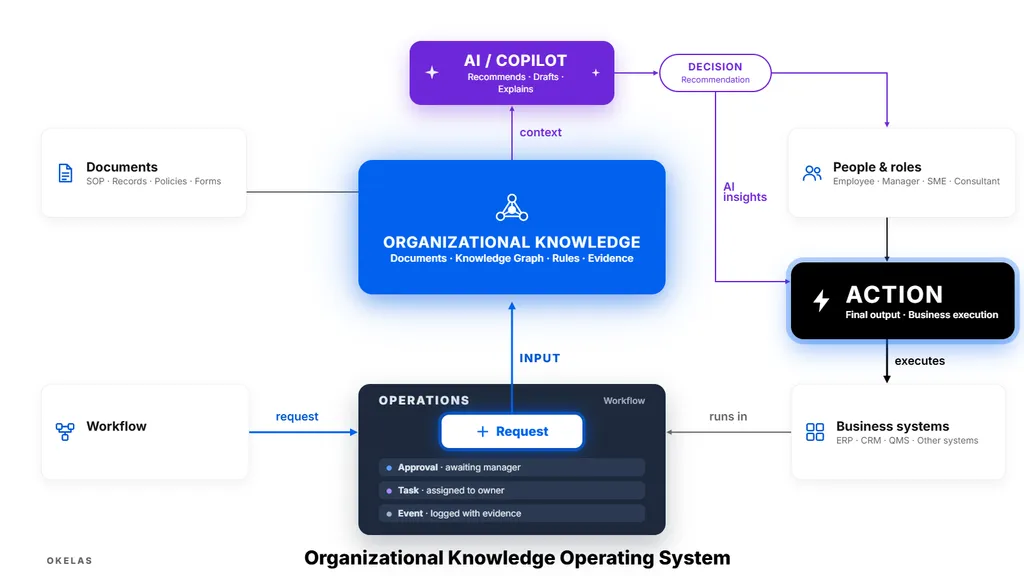
OKELAS connects people, processes, documents, events and evidence into one shared operating context, so information becomes decisions and action instead of staying scattered across files, systems and individual experience.
You Don't Lack Software. You Lack a Shared Context.
Most small and mid-sized manufacturers already run accounting software and have an ERP or plan to adopt one. Many also maintain ISO/GMP systems with hundreds of SOPs and forms, and their people have started using AI. Even so, the same situations keep coming back:
- —SOPs exist, but each shift follows them a little differently.
- —A key person leaves, and the department spends months relearning what they knew.
- —Audit preparation takes weeks of chasing records.
- —The ERP is live, but the numbers that matter are still in spreadsheets and email.
- —Answering "Why did this batch go wrong?" takes three departments.
- —People write faster with AI, but work doesn't move any faster.
These problems look separate, but most of them share one root cause. Your company's information is spread across systems, files and people's heads. Nothing connects it into a shared understanding of how the business actually operates.
A Simple Analogy: The Operating System
Your computer runs Windows or macOS. Nobody buys a computer for its operating system. Without one, though, applications can't share files, and they can't tell who the user is or who is allowed to do what. The operating system is the common environment that lets everything work together.
Your company has applications too: ERP, accounting, quality systems, spreadsheets, documents, email, chat groups and AI tools. It also has hardware: people, machines and plants.
What's usually missing is the layer in between. In that layer, processes, permissions, documents, events and evidence are understood the same way by everyone.
Without that layer, people become the operating system. They remember, remind, forward, reconcile and re-explain. The business keeps running, but it depends on the memory and goodwill of a few individuals. When those people are busy, on leave or gone, everything slows down.
OKELAS is that missing layer.
What Is OKELAS?
OKELAS is an Organization Knowledge Operating System for small and mid-sized manufacturers. Many companies operate on scattered documents and personal experience. OKELAS helps them operate on processes, workflows, evidence and organizational knowledge instead.
Put simply, OKELAS connects links in a chain that today sit in different places:
| Link | What it means | Where it usually lives today |
|---|---|---|
| Process | How work should be done | SOP files, ISO manuals |
| Workflow | How work actually moves: who does it, which step it's at, who approves | Email, chat, verbal reminders |
| Event | What happened, when and where | Logs, shift reports, spreadsheets |
| Evidence | Records that prove the work was done right | Folders, paper, personal laptops |
| Knowledge | What the organization has learned and can reuse | Experienced people's heads |
| Decision → Action | Who decides, on what basis, and what happens next | Meetings, messages |
Once these links are connected, a company doesn't just store information. It understands that information and uses it in day-to-day operations. That is what organizational knowledge management looks like in practice on the factory floor.
An illustrative example (hypothetical scenario, not a customer case): a production batch is found to be out of specification.
Without a shared operating layer:
QA opens a spreadsheet, calls the shift lead, hunts for inspection records and asks whoever handled the issue last time. The resolution ends up in an email that few people will ever find again.
With the OKELAS approach:
The event is recorded and linked to the batch, the process step, the current SOP version, the responsible person and the related records. Whoever handles it knows the next step and who must approve. The resolution becomes organizational knowledge for next time.
To be clear
What OKELAS Is Not
OKELAS is not the following.
Not an AI chatbot
AI is one layer in OKELAS, not its center. OKELAS does not work as a general-purpose chat assistant.
Not a document repository
Storing documents is not the same as managing knowledge. OKELAS connects knowledge to real operations.
Not an ERP or an ERP replacement
An ERP records transactions. OKELAS holds the understanding around those transactions: process, context, evidence and knowledge. OKELAS doesn't compete with ERP — it helps companies prepare for their ERP, understand it and get more out of it.
Not a heavyweight enterprise system
OKELAS is built for small and mid-sized manufacturers. You start with a specific problem and grow from there.
Why This Matters More in the Age of AI
Companies are starting to run into a paradox:
AI can help a 50-person company produce the paperwork of a 500-person company. That doesn't mean the 50-person company can handle the workload of 500.
Reports, emails, proposals and documents get produced faster. But if processes, responsibilities, approvals and evidence stay fragmented, more information just means more to read, reconcile and search through.
The question is no longer "How do we create information faster?" It is "Does the organization turn information into process, decisions and action?"
That's why AI is not the center of OKELAS. AI works inside the organization's context: it understands the process, finds the right evidence, supports the workflow and leaves a trace that can be checked. A good answer isn't just correct. It can be explained, backed by evidence and traced.
Diagnostic-Led Advisory
Assess First. Improve Immediately. Configure from Reality.
Every organization starts from a different operational state. So OKELAS doesn't start by installing software. It starts with a business readiness assessment across six pillars — each one shows what you can fix now and becomes the baseline for configuring OKELAS around how your company really works.
01 — Digitalization
Which processes and data are still handled manually? Find where digitizing pays off first.
02 — Workflow
Who does work pass through, and where does it stall? Spot bottlenecks, repeated data entry and approval gaps.
03 — Knowledge
Where does knowledge live, and who does it depend on? Reduce dependence on individuals and loose files.
04 — ERP Readiness
Are processes, data and people ready for ERP? Avoid implementing ERP on weak foundations.
05 — AI Readiness
Which AI uses are realistic with today's data and processes? Focus on AI that can actually work.
06 — Quality / eQMS
How mature are your records, evidence and quality discipline? Strengthen ISO/GMP compliance and operational discipline.
From Assessment to Operating System: A Closed Loop
Assessment results don't end up in a report on a shelf. They become a model of the organization itself — the baseline for configuring OKELAS around the way the company actually operates. Once OKELAS is running, real operating data flows back into the assessments.
Assess
Evaluate current operational state across six pillars: Digitalization, Workflow, Knowledge, ERP, AI, Quality.
Improve
Act on what you can fix immediately — whether or not you ever use OKELAS.
Configure
Assessment results become the baseline for configuring OKELAS around how the company really works.
Operate → Measure → Reassess
Assessment is not a one-off exercise but a loop: Assess → Improve → Configure → Operate → Measure → Reassess. OKELAS is built from the way the company actually operates.
Components
Components: Use What You Need, Configure as You Grow
No company needs everything on day one. Depending on maturity and needs, you can start from your most pressing problem.
OKELAS Core
The foundation for processes, workflows, events, evidence, permissions and knowledge relationships across the organization.
Knowledge Graph
The layer that links knowledge to people, processes, documents, events and decisions, so knowledge can be queried, verified and explained.
Copilot / Agent
AI that works within the organization's context, with defined tasks, permissions and evidence. It is not a general-purpose chatbot.
ERPNext + ERP Knowledge Graph
ERPNext serves as the transactional backbone where it fits. The ERP Knowledge Graph maps the ERP's structure, business rules and customizations to support implementation and day-to-day use.
ERP Sandbox
A safe environment for testing changes and customizations before they touch the live ERP.
Start from your problem
Begin with Digitalize Operations, Standardize Processes, Progressive eQMS or ERP Readiness — wherever the business needs it most.
How we work
Principles We Hold To
Smallest sufficient system.
We use the smallest system that solves the problem and don't build large systems just to showcase technology.
On-premise by default.
OKELAS is deployed on-premise by default, so your data and knowledge stay on your own infrastructure. You don't have to move data to the cloud or take on a stack of SaaS subscriptions. This matters especially for companies with sensitive data or compliance requirements.
Price / performance.
Costs must match the value delivered. Infrastructure, licensing, implementation, maintenance and AI costs are all sized for small and mid-sized companies.
Explain → Evidence → Trace.
Every answer should be explainable, backed by evidence and traceable. This matters especially under ISO and GMP.
One step at a time.
Move from digital documents to workflow, then to knowledge, then to AI. Each step must make economic sense on its own.
Who It's For
OKELAS is built for CEOs, owners and leadership teams of small and mid-sized manufacturers, especially companies that:
- —operate in food, processing, seafood, tea or other ISO/GMP-regulated industries;
- —have many SOPs, forms and records but struggle to get them followed consistently;
- —are preparing for ERP, or already run an ERP without well-organized processes and knowledge;
- —want to use AI but aren't sure their data and processes are ready.
Insights Library
Learn Before You Decide
Our Insights library is written for manufacturing leaders and organized around the same six pillars as the assessment. Read → Understand → Assess → Discover → Engage.
Digitalization
Operational problems rarely announce themselves as "we need to digitalize."
Knowledge Management
Getting knowledge out of a few people's heads so the organization can find it, reuse it and hand it to AI systems.
ERP
Why ERP projects miss their goals, and why the real problem usually isn't the software.
Where Does Your Business Stand?
You don't need to start with a big project. Start by seeing clearly how your company actually operates.
Don't start with software. Start with how your business really runs.