
Programmed vs. Nonprogrammed Decisions: Rules, Judgment, and Where Each Belongs
2026-09-23
Executive Summary
- When designing a workflow that involves AI, the most practical question isn’t “which AI to use” — it’s: should this step be a hard rule, or does it require human judgment?
- Herbert Simon — economist and Nobel laureate (1978) — drew a clear distinction in 1960: programmed decisions (repetitive, clearly structured, handled by procedures) and nonprogrammed decisions (novel, complex, requiring judgment). The distinction still holds.
- What sits at the “needs judgment” end belongs to people. Systems can prepare input — interpreting unstructured data, assembling evidence — but the authority to judge stays with humans, not AI.
- When enough precedent accumulates, human judgment can become a proposed rule → human review and approval → then a rule. The scope of judgment narrows over time because more rules get issued — not because more authority is delegated to AI.
When a team starts designing a workflow that involves AI, one question comes up quickly: should this step be a rule in the system, or should someone make a judgment call each time? It sounds like a technology question, but it’s actually a governance question that was studied long before modern AI existed.
In 1960, Herbert Simon — who later received the Nobel Prize in Economics in 1978 — published “The New Science of Management Decision,” in which he drew a distinction that still holds up today: the difference between programmed and nonprogrammed decisions.
→ Related: From Request/Approval to Event/Action: Rethinking How Work Flows
Two Types of Decisions, One Continuum
In “The New Science of Management Decision” (1960), Simon distinguishes:
Programmed decisions: repetitive, clearly structured, handled through established procedures or automated systems. When criteria are stable and can be written down, these decisions are good candidates for workflow rules — there’s no need to involve a person’s judgment each time, and doing so just adds latency.
Nonprogrammed decisions: novel, complex, requiring judgment and weighing multiple factors at once. The variations can’t all be enumerated in advance. These belong to people. A system can prepare the inputs — interpreting unstructured documents, assembling evidence from similar past cases — but the authority to decide stays with a person, not an AI.
Simon also emphasized: programmed and nonprogrammed are two ends of a continuum, not two fully separate boxes. Most real business decisions sit somewhere in between — and the position isn’t fixed. It can shift toward the programmable end as experience accumulates.
What AI adds to this picture isn’t a third layer of judgment sitting between rules and people. AI enters in two supporting roles: interpreting unstructured inputs so rules can run, and assembling evidence so people can decide faster and with better grounding.
Four Criteria for Placing a Decision

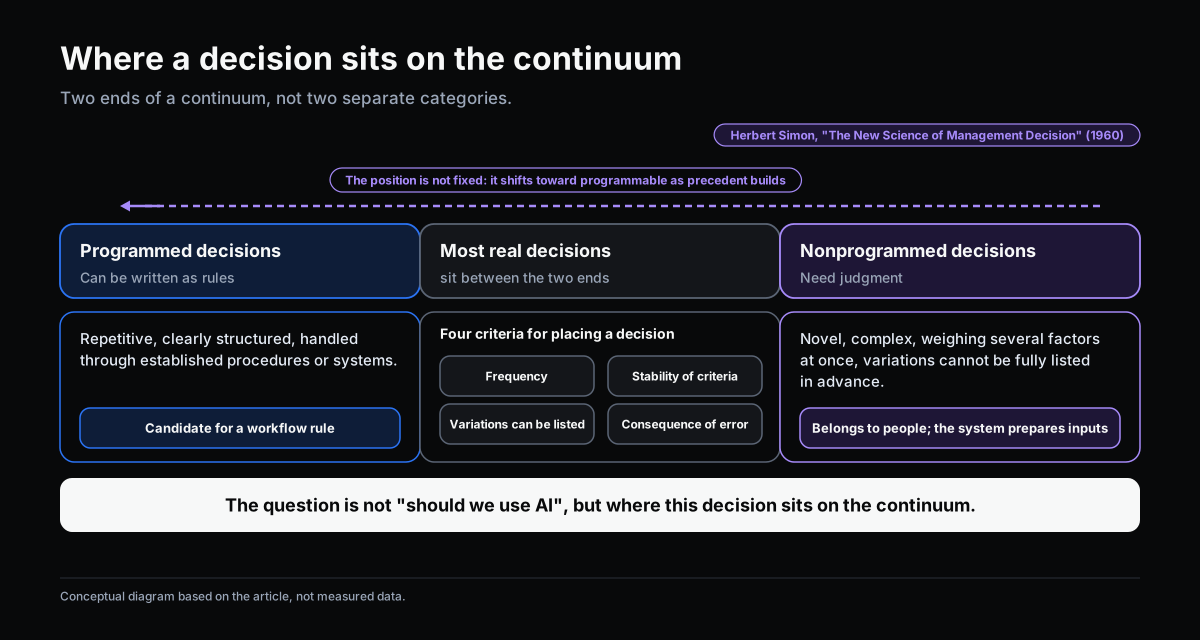
To determine where a specific decision sits on the continuum — and what mechanism fits best — four practical questions:
1. Frequency. Does this type of situation arise daily, weekly, or only a few times a year? Higher frequency increases the payoff of writing a rule. A rule used hundreds of times is worth the investment; a rule used twice a year may not be.
2. Stability of criteria. Do the decision criteria shift with seasons, policy changes, or market conditions? Stable criteria make rules durable. Frequently-changing criteria mean rules need constant maintenance — and an unmaintained rule is often worse than no rule at all.
3. How enumerable the variations are. Can you write down most of the cases that could realistically arise, or do new variants keep appearing? If you can’t enumerate, a hard rule will keep missing edge cases — and the cases it misses tend to be the ones that matter.
4. The consequence of getting it wrong. If a rule is applied incorrectly to an exception, how serious is the result? High consequence means keeping a person at the confirmation step, or at minimum at an exception approval step.
These four criteria don’t produce a binary answer. They help locate a decision on the continuum and choose the right mechanism.
Decision Type Table: Who Handles What

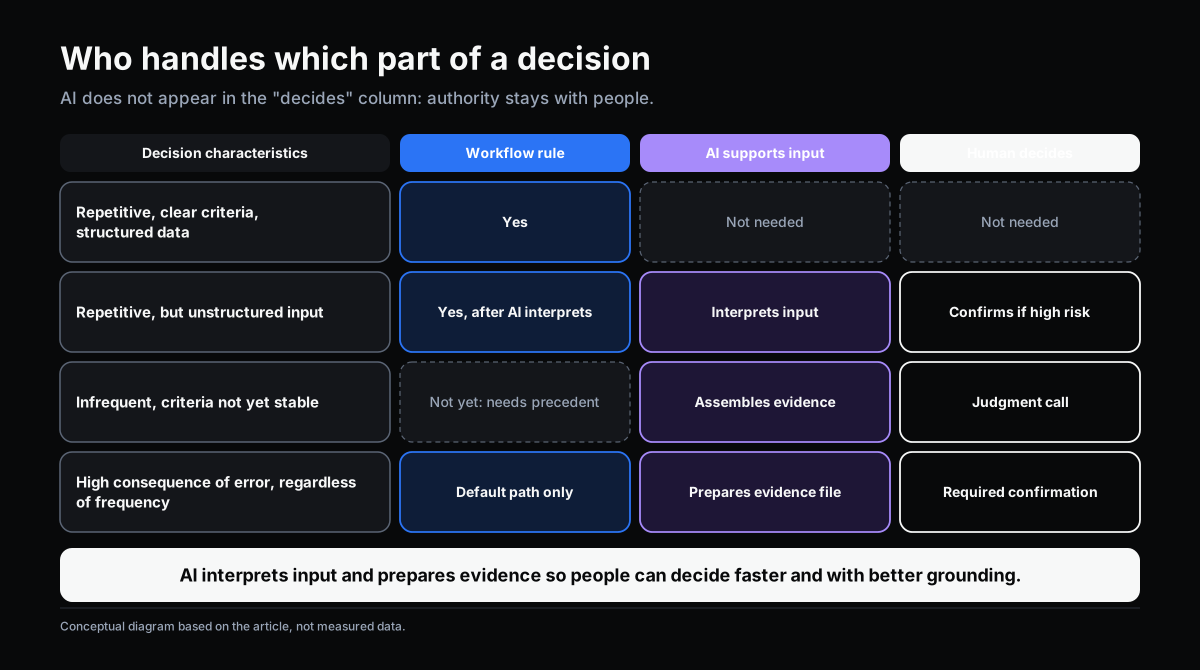
| Decision characteristics | Workflow rule | AI supports input | Human decides |
|---|---|---|---|
| Repetitive, clear criteria, structured data | Yes | Not needed | Not needed |
| Repetitive, but unstructured input (text, email) | Yes — after AI interprets | Interprets input | Confirms if high risk |
| Infrequent, criteria not yet stable | Not yet — needs precedent | Assembles evidence | Judgment call |
| High consequence of error, regardless of frequency | Default path only | Prepares evidence file | Required confirmation |
The key point: AI doesn’t appear in the “decides” column. AI appears in the “supports input” column. Authority stays with people; AI interprets and prepares so people can decide faster and with better information.
Related: AI in Workflow: Mapping Where It Fits and What It Should Do
When Precedent Accumulates: From Judgment to Rule

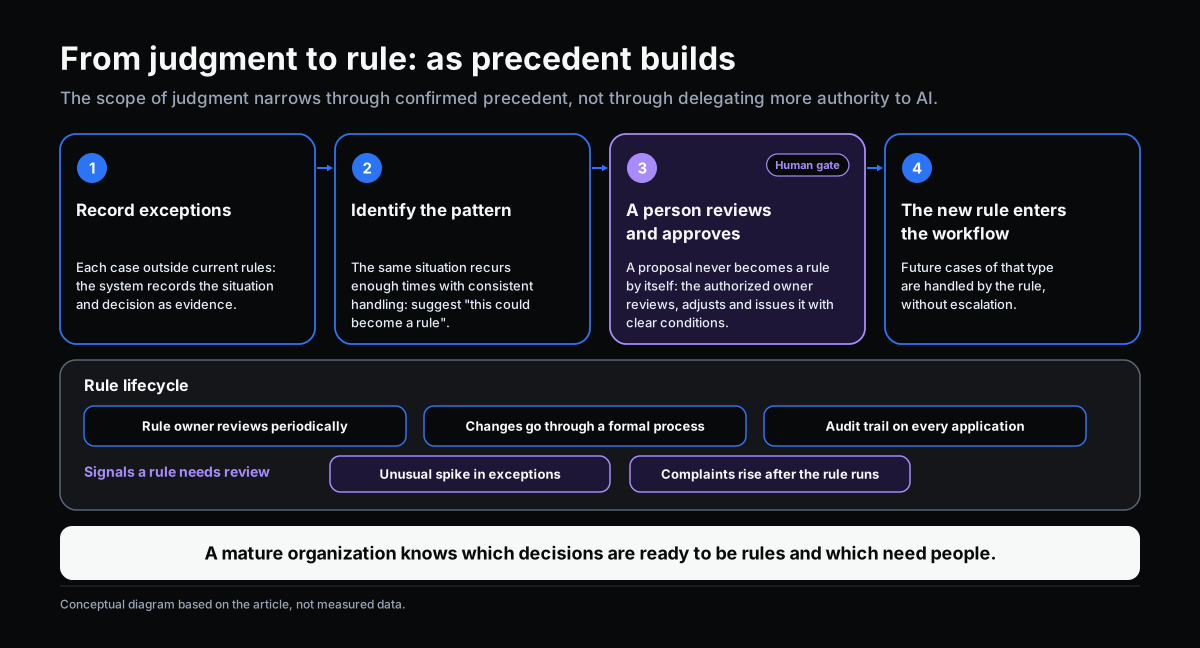
One of Simon’s points that’s easy to miss when applying this framework to system design: the position on the continuum isn’t fixed. When enough precedent builds — when a type of decision has been handled by people many times with consistent outcomes and the pattern is clear — it can gradually become programmable.
The right mechanism for this transition:
Step 1 — Record exceptions. Each time a person handles a case that falls outside existing rules, the system records the situation and the decision as evidence — not to train AI to decide independently, but to accumulate verifiable precedent.
Step 2 — Identify the pattern. When the same type of situation appears enough times with consistent handling, the data is sufficient to suggest: “this could become a rule.” The suggestion could come from AI pattern recognition or from an operations team member reviewing the log.
Step 3 — A person reviews and approves. A proposed rule doesn’t become a rule automatically. The rule owner reviews the proposal, adjusts if needed, and issues it formally with clear conditions.
Step 4 — The new rule enters the workflow. Future cases of that type are handled by the rule, without escalation. The scope requiring human judgment shrinks.
This is why the scope of human judgment narrows over time — not because more authority is delegated to AI, but because more rules get issued based on real experience, confirmed by people with authority.
→ Related: Exception Handling in Business Workflows
Rule Lifecycle Management
Rules don’t manage themselves. A mature workflow operation needs active rule lifecycle management:
Rule owner: every rule needs someone responsible for periodic review. Not necessarily IT — usually the operations person who understands the context and knows when conditions are shifting.
Rule change process: when the environment changes (new policy, new product, new customer requirement), rules need to be updated through a formal process — not edited directly in the system without a record. Untraced changes make it impossible to understand why a rule behaves the way it does.
Audit trail: each time a rule is applied, it should leave a trace. This enables post-hoc verification and early detection of when a rule is starting to misfire.
Signals that a rule needs review: an unusual spike in exceptions suggests the rule isn’t covering enough cases; complaints after rule execution suggest the rule is running in the wrong direction.
Organizations that don’t manage rule lifecycle find that old rules accumulate and become a source of exceptions — the environment has changed but the rules haven’t.
Decision Inventory Checklist
Before designing or redesigning a workflow, a decision inventory is the step most commonly skipped — and the one that creates the most value.
For each step in the process, answer:
- What type of decision does this step require? (approval, classification, routing, calculation, confirmation, escalation?)
- Have the criteria for this decision been written down, or do they live in one person’s head?
- What percentage of real cases are handled using the same logic?
- When the logic can’t be applied, where does that decision go? (proper escalation? bypassed? handled off-system via chat or email?)
- If the person responsible is away for a week, how does this step get handled?
The output of the inventory isn’t a list of things to delegate to AI. It’s:
- Decisions that can be encoded as rules now (sufficient frequency, stable criteria, low consequence of error);
- Decisions that need more precedent before a rule can be written;
- Decisions that must stay with people because the consequence of error is too high or criteria are too volatile.
→ Related: Segregation of Duties When Using AI in Workflows
Conclusion
The real question isn’t “should we use AI here” — it’s “where does this decision sit on the continuum, and what mechanism fits that position best?”
Simon’s 1960 framework is still the right tool for answering it. What AI adds isn’t a new layer of judgment — it’s the ability to prepare better inputs: interpreting unstructured data so rules can run, and assembling evidence so people can judge faster and with better grounding.
A more mature organization isn’t one that delegates more to AI — it’s one that knows which decisions are ready to encode as rules, which require people, and has a working mechanism for systematically converting human judgment into rules as experience and confidence accumulate.
This article is part of a series on workflow design, AI adoption, and operational management for manufacturing SMEs.
Related articles:
- From Request/Approval to Event/Action: Rethinking How Work Flows
- Exception Handling in Business Workflows
- AI in Workflow: Mapping Where It Fits and What It Should Do
- Segregation of Duties When Using AI in Workflows
→ Complete the Digitalization Readiness Assessment
Does this describe your organization?
Does this sound familiar to your organization?