
One Engineer's Laptop, Billions at Stake: Do You Know How Far Your People's Access Reaches?
2026-11-01
On October 29, 2026, Binance disclosed a security incident it estimates affected about $6.3 billion in assets. According to Binance’s own preliminary investigation, the starting point may have been the laptop of a DevOps engineer.
Most commentary has focused on the attackers, the technique and the amount. This article asks about the blast radius of compromised access, a question that applies to the leader of any organization, including a factory or a manufacturer with no connection to crypto:
If one employee’s device were taken over, could you immediately say which systems and assets that device, that account and that person can reach?
For most organizations the honest answer is: not quickly, and not with confidence. That is no longer only a security-team problem. It is a question of whether the organization actually understands its own systems, which makes it a knowledge-management problem.
One clarification up front: this article does not assess how Binance runs its internal governance. We have no visibility into that, and the official root cause has not been fully published. The incident is used here only as a public case for asking questions of other organizations.
Executive summary
- A hypothesis that a laptop was the entry point does not mean one individual caused the incident or is responsible for it. Binance says it has not attributed responsibility to any individual, and that it has found additional points of breach.
- A person’s real authority is not only what they are allowed to decide. It is what the systems allow them to affect. The two often differ, and they are rarely recorded in one place.
- An organization can hold huge volumes of logs, documents and procedures and still lack knowledge of its own systems: who is tied to which device, which device reaches which service, which service touches which asset.
- Knowledge management does not replace cybersecurity. It helps an organization know what each security layer is for, what it protects, and how far the damage extends when a layer fails.
- A simple test: within minutes, can you answer “if our most critical person lost control of their work device, what could someone else do through it?”
What has been reported, and what has not
The information below is current as of November 1, 2026, based on Binance statements and independent reporting. The investigation is ongoing.
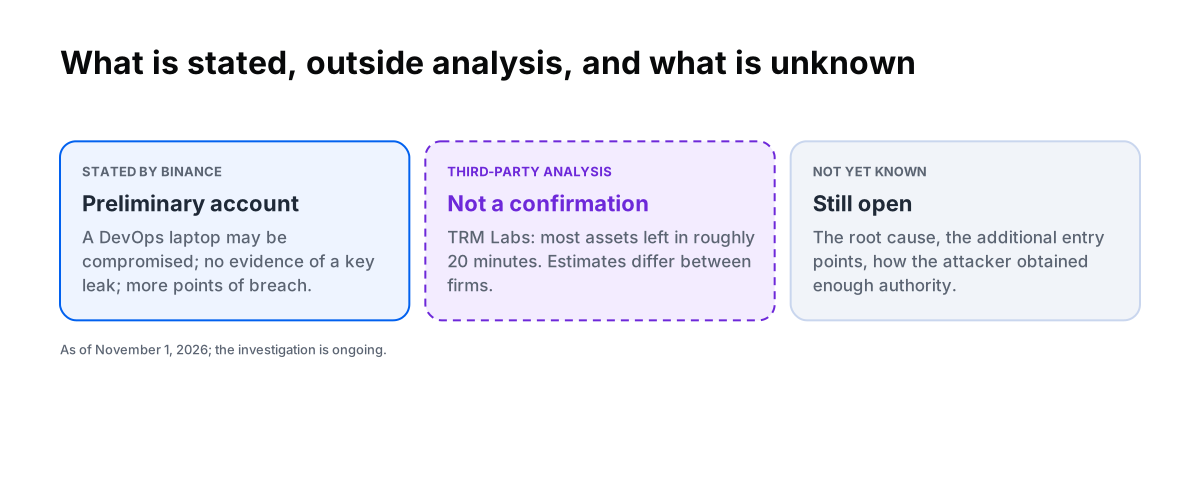
Figure 1. Three levels of certainty in the reporting on the incident, as of November 1, 2026.
Stated by Binance or reported by multiple independent outlets:
- Binance estimates the impact at about $6.3 billion, which it describes as preliminary and unaudited. Blockchain analytics firms cite different figures, from just under $6 billion to more than $6.4 billion. The figure should not be read as the final net loss.
- Binance’s initial investigation suggests the incident “may involve” a compromised DevOps engineer’s laptop, which gave an attacker access to a service container used to submit unauthorized withdrawal transactions.
- Binance says it has found no evidence that a wallet private key leaked.
- Binance later said it uncovered additional points of breach, and its leadership stressed that this was not a single action. Those points have not been described in detail.
- Binance says it has not attributed responsibility to any individual.
- About $3 billion has been traced and frozen, according to Binance. Analysts cite lower figures, and Tether and Circle have disclosed the stablecoin amounts they froze.
- Binance has committed to covering user losses through its SAFU fund and company resources.
Third-party analysis, not confirmed by Binance:
- Blockchain analytics firm TRM Labs says most of the assets left Binance-controlled wallets in roughly 20 minutes, after substantial preparation beforehand.
- Attribution to a specific threat group comes from private analytics firms and had not been confirmed by Binance or authorities in the sources we reviewed. This article does not rely on it.
Not yet known: the official root cause, the specific additional entry points, and how the attacker obtained enough authority to execute the transactions. Binance says a post-incident report will follow once facts are verified.
One detail is easy to misread. “The engineer’s laptop was the initial entry point according to the investigative hypothesis” does not mean “the engineer caused the incident.” A person can be the way into an attack without personal fault. The lesson is that the organization’s job is to design so that a single point is not enough to cause damage at that scale.
The question is not “who failed” but “what can it reach”
Consider an engineer who operates systems in an ordinary organization. They cannot approve payments, sign quality records or hold the secret keys to any system. On the org chart, their decision authority is narrow.
But their job requires logging into servers, reading configuration, deploying services and fixing problems at midnight. To do that, they hold technical permissions that nobody thinks of as “decision rights.”
That is the core point:
A person’s real authority is not only what they are allowed to decide, but what the systems let them affect.
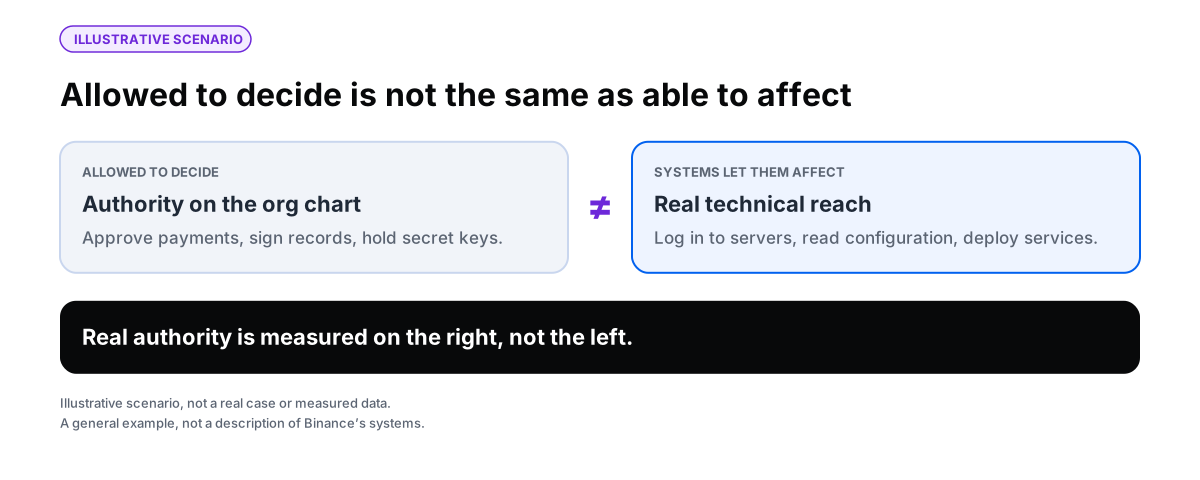
Figure 2. Decision authority and the ability to affect are two different things.
From a knowledge-management view, four layers need to be separated, and they are seldom modeled together:
| Layer | Question |
|---|---|
| Personal knowledge | What does this person know about how the system works? |
| Access | Which components is this person allowed to reach? |
| Capacity to act | What can this person actually change? |
| Organizational control | How far does the organization limit and monitor that capacity? |
The gap usually sits between the second and third layers. The list of granted permissions exists. The real consequence of those permissions combined is something nobody has worked out.
Five knowledge-management gaps behind the case
The five gaps below are our reading, using the incident as a discussion case. They are not investigative findings about Binance.
1. Knowledge and authority concentrate in one place
A long-serving engineer is often the only person who understands which connections exist between services and also holds the permissions to act on them. Knowledge and authority pile up in one person, and then on one device.
When both sit at the same point, that point becomes the most valuable target, because taking it yields both understanding and the ability to act. If the organization has not mapped such points, it finds them only after an incident.
2. Tacit knowledge becomes systemic risk
DevOps holds an unusual amount of tacit knowledge. A veteran engineer may know which service calls which, which container can reach another system, which deployment procedures have exceptions, and which configurations were built for a one-off situation.
Some of this is not in any official document. The organization believes it is in control because procedures, documentation and permissions exist, yet its real operating capacity depends on what a few people understand.
This is a form of knowledge concentration risk: operating capability and risk surface live together in the heads, and on the devices, of a handful of individuals. The goal is not to eliminate tacit knowledge, which is nearly impossible (the concept goes back to Polanyi, 1966). The goal is to convert the important parts into knowledge the organization can inspect, assess and monitor, rather than leaving it in the memory of whoever happens to hold it.
3. Plenty of data about the system, little knowledge of the system
A company can keep millions of log lines, thousands of pages of technical documentation, hundreds of procedures and many audit reports. Ask whether it can answer these immediately:
- Which systems can a specific engineer affect?
- Which service containers can be reached from that person’s laptop?
- What actions can a given service container perform?
- Which assets or business processes could those actions affect?
- If an account is compromised, what is the maximum blast radius?
- Which permissions still exist but are no longer needed?
This is the difference between having data about a system and having knowledge of a system. Logs tell you what happened. Technical documents describe how the system was designed. The question “what if this point loses control” needs a model that connects people, devices, permissions, services, processes and assets. (The same pattern appears in Right Data, Wrong Decision: data becomes knowledge only with provenance, context and limits on what can be inferred.)
4. No way to trace the chain of impact
Picture a generalized chain of impact. This is an illustrative model for risk analysis, not a technical diagram that Binance has confirmed.
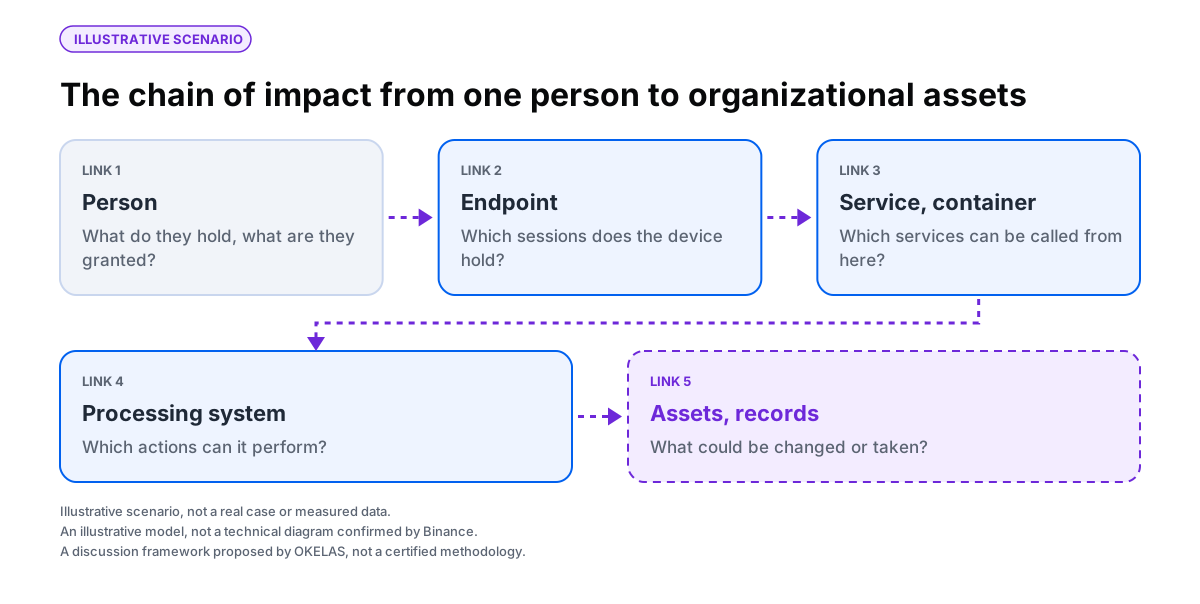
Figure 3. A generalized chain of impact, with a question for each link (illustrative model).
| Link | Meaning | Question the organization must answer |
|---|---|---|
| Person | Knowledge, accounts, access | What does this person hold and what are they granted? |
| Endpoint | Laptop, workstation | What sessions and credentials does this device hold? |
| Service, container | Connected technical components | Which services can be called from here? |
| Processing system | Systems that execute business actions | Which actions can this system perform? |
| Assets, records | Money, data, quality records | What could be changed or taken? |
When an account is found compromised, the organization needs to trace backward quickly: which people and devices does it relate to, what permissions does the device hold, which systems do those permissions lead to, which processes do those systems affect, and which assets or data are at risk.
This is not merely reading an activity log. It is tracing relationships between objects in the organization. In knowledge management this is what a knowledge graph does: it represents entities and relationships so that the scope of impact can be queried, instead of being pieced together by hand from scattered sources after the incident. The article Knowledge Graphs for Business goes deeper on this view.
5. No knowledge of exceptions
Procedures are usually written for normal conditions: a legitimate user, a safe device, a system doing what it was meant to do. An organization that actually controls its systems must also answer the opposite question: what happens when an important assumption stops being true?
- What if an engineer’s laptop is taken over?
- What if a legitimate account is being used by someone who is not legitimate?
- What if a service container does something outside its original purpose?
- What if a transaction is technically valid but anomalous for the business?
- What if both the person who approves and the person who executes are affected?
That is knowledge about exceptions, risk and incident response. A procedure that describes only the normal state is not enough to show that the organization has control.
Cybersecurity and knowledge management: complementary, not interchangeable
The two views differ in the kind of question they ask:
| Traditional security view | Knowledge management view |
|---|---|
| Who has access? | Why does this person need this access? |
| Which devices may connect? | Which knowledge and assets can that device affect? |
| Which systems are running? | How do the systems depend on each other? |
| What do the logs record? | What does the event mean in the organization’s context? |
| Is there an incident response procedure? | Does the organization know which procedure to trigger, and on what evidence? |
| Have employees been trained? | Has their real capability been assessed? |
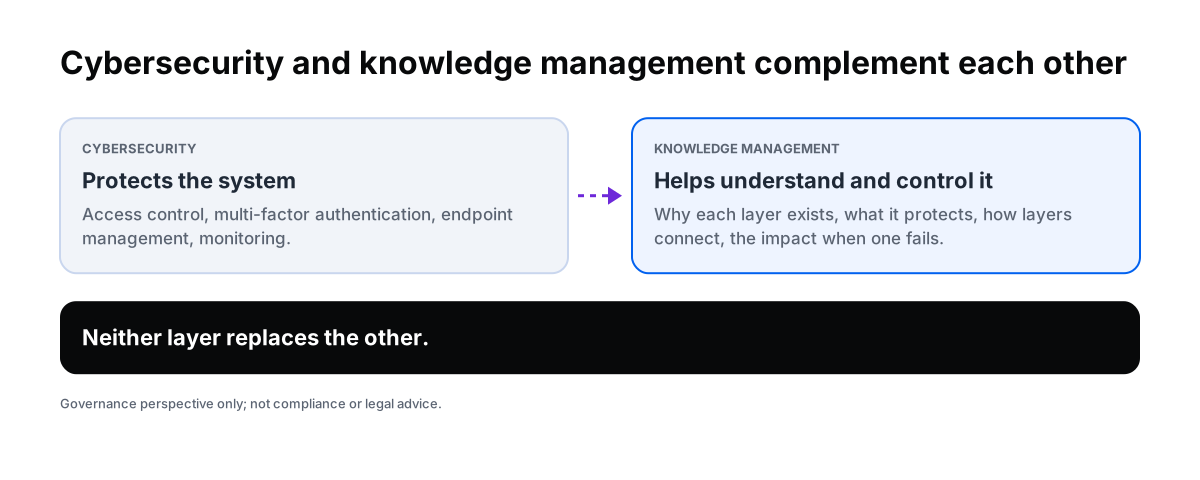
Figure 4. Two layers both needed, each answering a different kind of question.
This does not mean knowledge management can replace cybersecurity. Access control, multi-factor authentication, endpoint management, secrets management, network segmentation, the principle of least privilege (described since the mid-1970s), transaction controls and monitoring remain mandatory technical layers. This article offers no technical security recommendations.
What knowledge management adds is reason and context: why each protective layer exists, what it protects, how the layers connect, and what the scope of impact is when one fails.
In short: cybersecurity protects the system; knowledge management helps the organization understand and control the knowledge, capabilities and relationships that make up that system.
Three states of knowledge when assessing blast radius
As an organization starts answering these questions, one discipline is worth keeping, especially if AI is used to support the queries. Each risk conclusion should carry one of three states:
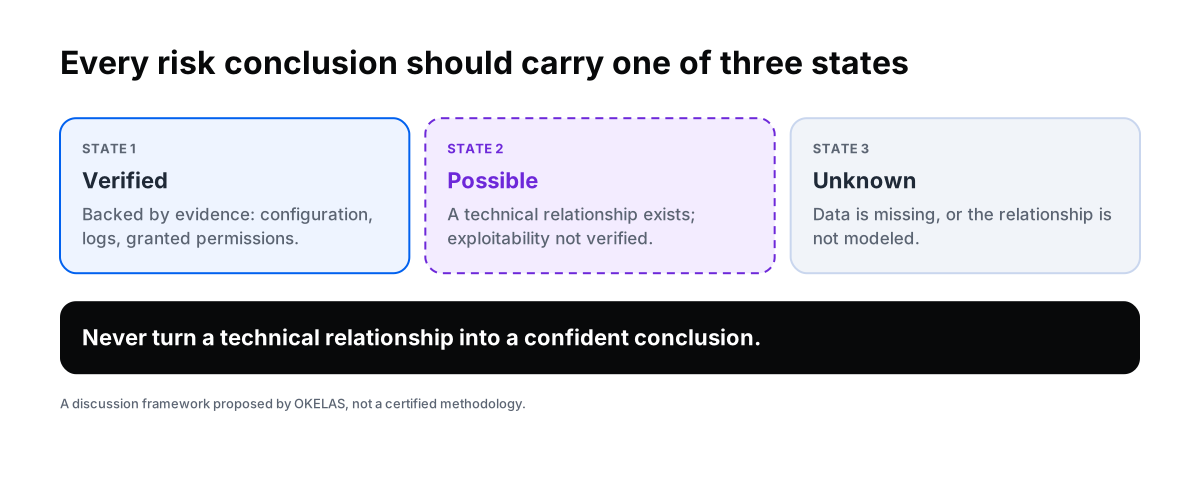
Figure 5. Three states of knowledge when assessing blast radius.
- Verified: supported by evidence (configuration, logs, permission records).
- Possible: a technical relationship exists, but exploitability has not been verified.
- Unknown: data is missing, or the relationship has not been modeled.
Do not let any tool, AI included, turn a technical relationship into a confident conclusion about a vulnerability. A system that honestly says “unknown” is better than one that gives a confident answer without evidence. The same principle sits at the core of AI prepares the evidence, humans decide.
For ISO/GMP manufacturers
In a factory, the consequence of an account used without authorization is not limited to data loss. It can affect:
- changes to SOPs;
- edits to process parameters;
- approval of quality records;
- retrieval of batch production data;
- the integrity of records used for audits and inspections.
Here information security, compliance and knowledge management are no longer separate subjects. The question “who may affect which record, and on what evidence” is a security question, a compliance question and a knowledge question at once. (Governance perspective, not security, compliance or legal advice.)
Six self-check questions for the executive team
The six groups below are a discussion framework proposed by OKELAS, not a certified methodology. They measure governance capability, not which software has been installed.
| Group | Core question |
|---|---|
| Knowledge ownership | Do we know who is responsible for each critical system and asset? |
| Access governance | Is access granted by role and job need, and reviewed regularly? |
| Knowledge continuity | Does any process or system depend on one person’s knowledge? |
| Traceability | After an incident, can we trace the chain of impact from person to asset? |
| Exception management | Do we have a way to respond when normal operating assumptions break? |
| Evidence | Can we prove our controls are actually working? |
A practical quick test:
If tomorrow your most critical employee lost control of their work device, could you determine within minutes what someone else could do through it?
If the answer is “it would take days and many people to ask,” that is not a verdict on people or technology. It is an organizational knowledge gap, and it can be worked on.
Next step
We suggest starting not with a new tool but with a short mapping session on one small area: choose a critical system, list who and which devices can reach it, and time how long a complete answer takes. The result usually shows where the organization stands better than any scorecard.
Further reading:
- (pillar) Knowledge Management for Manufacturing: From Individual to Organizational Knowledge
- (related) Tacit vs. Explicit Knowledge: Why the Distinction Matters
- (related) Least Privilege for AI Agents
- (related) Every AI Agent Needs an Authority Profile
Source notes
- Binance security incident update, October 30, 2026 (via CoinDesk/Yahoo Finance and The Hacker News reporting, October 30, 2026): the DevOps engineer laptop hypothesis, the service container, no evidence of a private key leak, additional points of breach, no attribution to an individual, the $6.3 billion estimate (preliminary, unaudited), about $3 billion frozen.
- Forbes Digital Assets, October 30, 2026: statements by Binance leadership that this was not a single action and that additional points of breach were found.
- Gizmodo, October 30, 2026, citing TRM Labs: most assets left within roughly 20 minutes. Chainalysis, Elliptic and TRM give different estimates for total size and frozen amounts. This is third-party analysis.
- Polanyi, M. (1966). The Tacit Dimension. Saltzer, J. H., and Schroeder, M. D. (1975). “The Protection of Information in Computer Systems,” Proceedings of the IEEE 63(9): the origin of the principle of least privilege.
- The chain-of-impact model, the six-group framework and the three states of knowledge are discussion frameworks proposed by OKELAS, not certified methodologies. This is analysis from a governance perspective, not security, compliance or legal advice.
Does this describe your organization?
Does this sound familiar to your organization?