
The Red Army in 1941: When Capable People Stop Seeing the Same Reality
2026-10-24
By one count, Stalin received around 87 credible intelligence warnings of a German attack during 1940 and 1941.1 On 22 June 1941, the attack came anyway, against what was still the largest military force in the world.2 Within a week, two Soviet army groups had been encircled around Białystok and Minsk.3
The Red Army did not lack people. It did not lack officers who would later become some of the most capable commanders of the war. It did not even lack information.
What it lacked in those first weeks was harder to see: the ability for those people and units to see the same reality, and to turn what they saw into coordinated action.
If you run a manufacturing business with several departments, several systems and several layers of reporting, this story is worth your time. Not because a company is a battlefield, but because the failure mechanism will feel familiar.
Executive summary
- The Red Army’s 1941 crisis was not mainly a talent problem. One of its weakest points was the connective tissue: communications, situational awareness, upward reporting and the ability to adjust decisions.
- Warnings existed, but were filtered before reaching the decision-maker.
- Once fighting began, commanders issued orders based on the picture in the plan, not the picture at the front.
- Recovery came partly from simplifying the structure to match real capability, not from adding reporting layers.
- AI amplifies whatever picture an organization feeds it. If that picture is filtered, late or stripped of context, AI just gets it wrong faster.
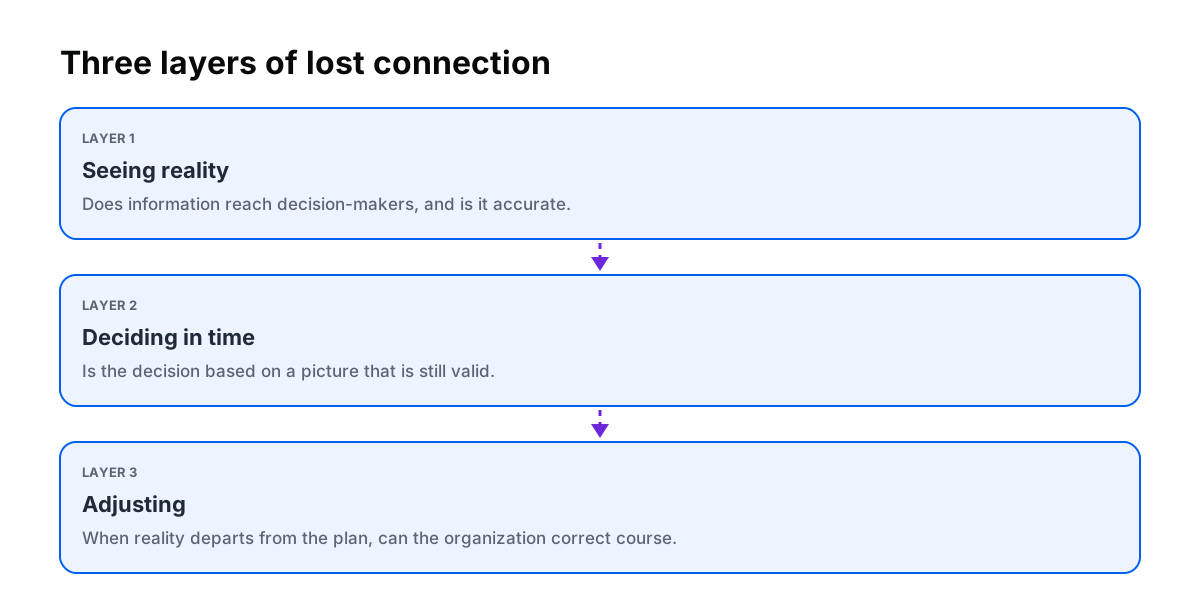
Figure 1. The three-layer model used throughout this article.
A giant organization whose weakest link was the connection
Historian David Glantz, whose study of the pre-war Red Army remains a standard reference, concluded that it was poorly trained, under-equipped and badly organized for large-scale campaigns.2 He singled out the signal troops as the weakest part of the entire force: short of equipment and people, and unable to perform their wartime mission.4
Communications relied heavily on fixed telephone lines, most of them unprotected. Once lines and nodes were cut, the shortage of radios and trained operators meant the whole system collapsed.5 Some accounts add that the Red Army had limited radio use in peacetime to avoid interception, so when war broke out, many units had neither the practice nor the right codebooks to communicate securely, and fell back on civilian phones.6
Analysis: The system did not “break” in the usual sense. It was designed for normal days, optimized for control and security. It was never designed for a day when everything changed by the hour.
Plenty of companies look the same. Processes work when orders are steady and suppliers deliver on time. When disruption hits, the real information flows through phone calls, private chats and the memory of a few key people.
Layer 1 — Losing sight of reality
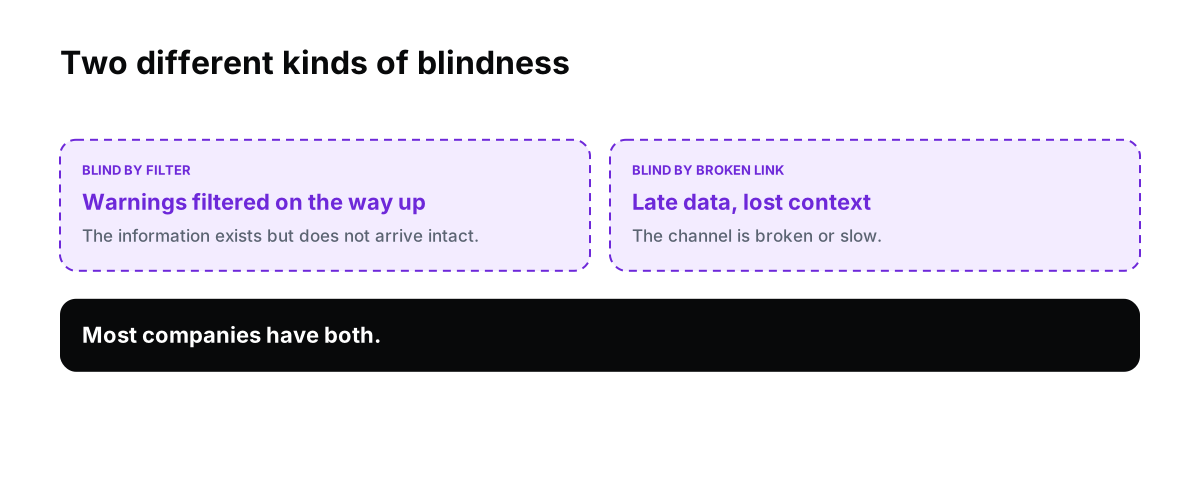
Figure 2. Two kinds of blindness at the seeing-reality layer.
The information existed. It was filtered on the way up.
General Golikov, then head of military intelligence, later admitted he had distorted intelligence to please Stalin because he feared him.7 Working from archival records, historian Gabriel Gorodetsky showed that many reports combined fairly accurate raw data on German deployments with reassuring judgments about German intentions.8 Golikov’s predecessor, who insisted on telling Stalin the truth, was shot in October 1941.1
To be fair, intelligence assessment is rarely clean. Germany ran a deliberate deception campaign, and the CIA review itself cautions against treating every warning as obvious in hindsight.1 Even so, one point holds: the data can be right and the conclusion reaching the decision-maker can still be wrong, because fear sits between the two.
When the fighting started, commanders lost sight of their own units
On the first day, the Western and Northwestern Fronts grew steadily more confused. According to the U.S. Army’s official history, their commanders, Pavlov and Kuznetsov, were out of contact with their own headquarters most of the time while trying to rally their forces.3 On the Southwestern Front, a staff officer later recalled that the first combat report sent to Moscow was mostly generalities.9
Analysis: These are two different kinds of blindness, and most companies have both:
- Filtered blindness: the information exists, but it is softened before it goes up. In business, that is the project that stays “on track” until the week it is suddenly late.
- Disconnected blindness: the information does not arrive in time, or arrives as an aggregate with no context. That is the dashboard updated at month-end, or the inventory figure that is correct in the system and wrong on the shelf.
Layer 2 — Deciding on an outdated picture
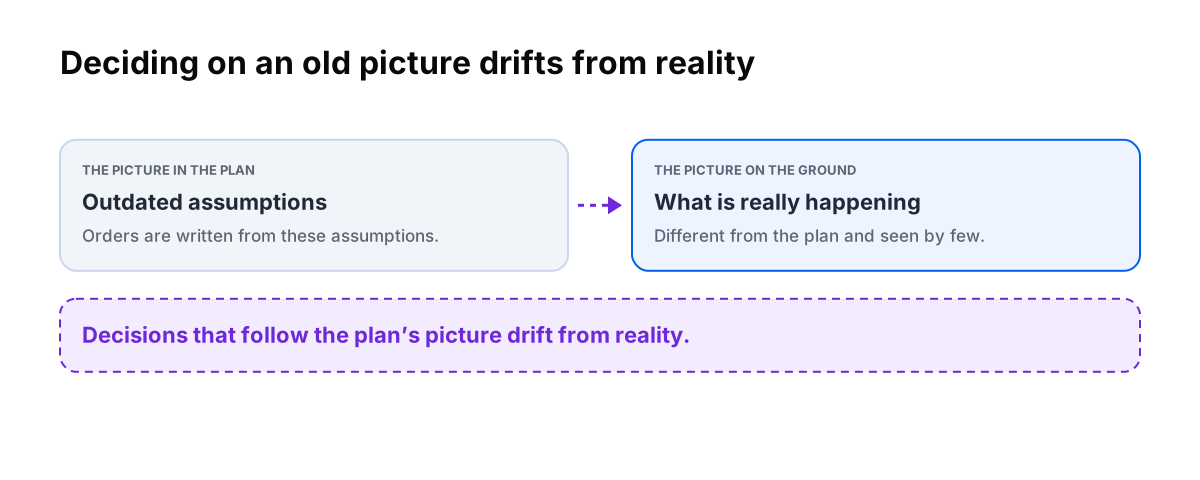
Figure 3. The plan’s picture and the real picture.
On the night of 22 June, Moscow issued Directive No. 3: a general counteroffensive. The Southwestern Front was told to use at least five mechanized corps to encircle the German forces and take the Lublin area, inside German-occupied Poland, by the end of 24 June.9
The order fit the pre-war plan. It did not fit the front. Zhukov, the Chief of the General Staff, who reached Southwestern Front headquarters that night, believed no counterattack or other concerted move should be attempted until a clear picture of the front had been formed.3 Many of the front’s own staff officers expected to stay on the defensive until things clarified.9
The result: except on the Southwestern Front, the main effect of the counterattack order was to pin Soviet units in exceedingly dangerous positions.3 By 29 June, German forces had closed two pockets east of Białystok and Minsk; German figures put the prisoners at over 300,000.3 By the fourth day of the war, the Soviet leadership recognized that both the directive and the whole idea of carrying the war onto enemy territory had been a mistake.3
Analysis: The order was right for the world in the plan and wrong for the world as it was. Any plan is a set of assumptions. When assumptions break and the organization has no fast way to notice and update, the plan itself becomes the risk.
In a company, that might be an annual budget built on raw-material prices that no longer apply, KPIs rewarding volume after customers shifted to quality, or an ERP configured around the process on paper rather than the way the plant actually runs.
Layer 3 — Losing the ability to adjust
The battle of Kiev in late summer 1941 shows a different kind of disconnect. This time, the danger was seen.
By early August, German advances had half-wrapped the Soviet forces around Kiev. Zhukov proposed giving up the city to avoid encirclement; Stalin refused and removed him as Chief of the General Staff.3 On 11 September, Marshal Budyonny asked to withdraw the Southwestern Front; he was refused and replaced.3 On 16 September the pocket closed. German figures counted 665,000 prisoners; the official Soviet history put the front’s strength at 677,085 at the start of the battle and 150,541 at the end.3
Analysis: At Kiev, the warning reached the top. Experienced people saw the danger and said so. But the decision process could not absorb a contrary signal, and speaking up carried real personal risk. In that kind of environment, the filter in Layer 1 does not need to be ordered. People filter themselves.
This is the part of “connection” that is easiest to miss: connection is not only a channel for orders to flow down. It is also a path for the truth to flow up without punishment.
How the Red Army reconnected
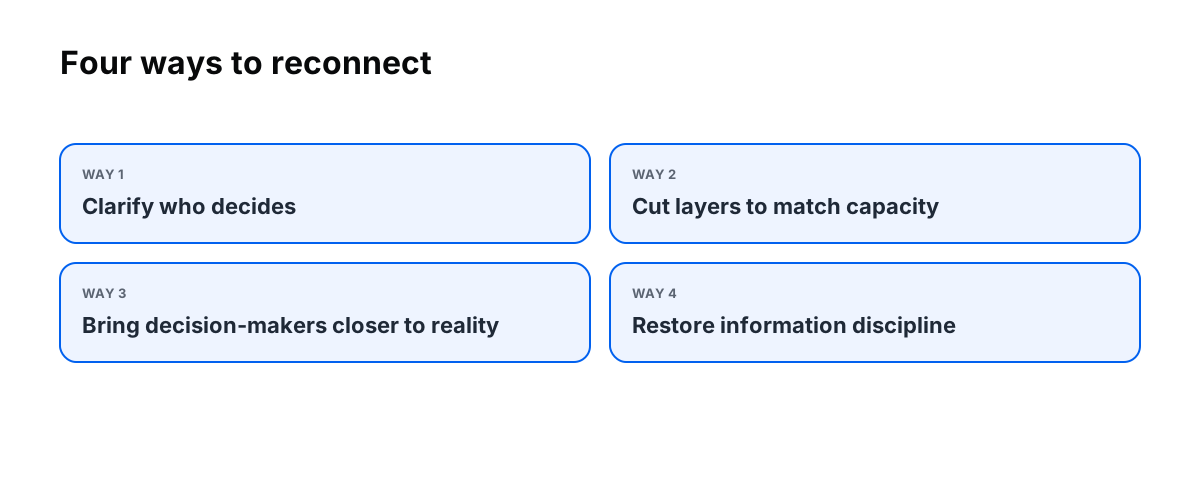
Figure 4. Four ways to reconnect.
The 1941 story does not end with failure, and the recovery is the more useful part.
- Clarify who decides. The Stavka (general headquarters) was set up on 23 June, and within days the strategy shifted to an “active strategic defense”: stop, hold and wear down the enemy while reserves were assembled.3
- Cut layers to match real capability. On 15 July, because there were not enough qualified officers to staff higher headquarters, the Stavka disbanded corps headquarters and had armies command divisions directly.3 Large mechanized corps were broken into smaller tank units.3
- Put decision-makers closer to reality. Sending Stavka representatives to the fronts became standard practice; Zhukov was almost always away from Moscow.3
- Restore information discipline. Signals-intelligence accounts suggest Soviet communications began improving by late September, and by November reinforcements arrived in front of Moscow under radio silence.10
Moscow held at the end of 1941. That was not due to these changes alone: autumn weather, overstretched German logistics and heavy German losses mattered a great deal.3 But one lesson is clear: they did not fix the disconnect by adding layers and reports. They simplified the structure to fit their real capability, and moved decisions closer to where the information was.
From the front line to the plant floor
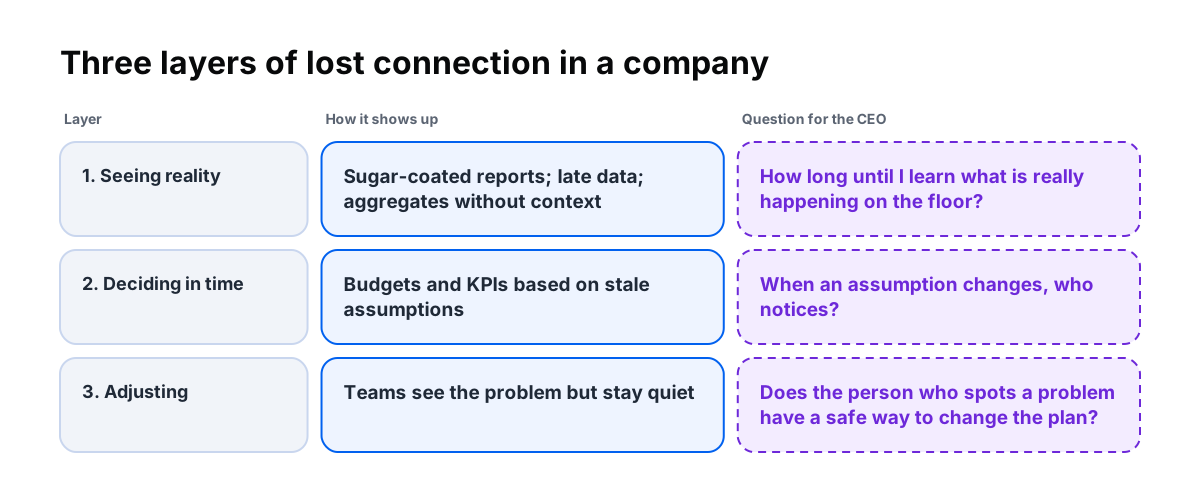
Figure 5. Three layers, how they show up, and questions for the CEO.
| Layer | Red Army, 1941 | What it looks like in a company | Question for the CEO |
|---|---|---|---|
| 1. Seeing reality | Warnings filtered; commanders out of contact | Sugar-coated reports; late data; aggregates without context | How long does it take me to learn what is really happening on the floor? |
| 2. Deciding in time | Counteroffensive ordered from outdated plan | Budgets, KPIs based on stale assumptions | When an assumption changes, who notices and how fast? |
| 3. Adjusting together | Withdrawal requests refused; messengers punished | Teams see the problem but stay quiet, or speak up and no one has authority to act | Does the person who spots a problem have a safe channel to change the plan? |
Where AI fits
AI can read, summarize and synthesize faster than any staff officer. But imagine giving the 1941 Red Army the best radios in the world while keeping a reporting culture in which no one dared deliver bad news. Information would move faster, and it would still be filtered.
The same applies inside a company. If the input data is polished, late, or detached from the processes and people responsible for it, AI will produce fluent summaries of a reality that does not exist.
Self-check: is your organization “out of contact” without knowing it?
Tick the statements that are true for your company:
- Bad news reaches leadership later than good news.
- Weekly or monthly reports rarely surprise leadership, but real incidents do.
- Two departments can give two different numbers for the same metric.
- In a crisis, information moves mainly through phone calls, private chats and a few key people.
- The annual plan is rarely revised mid-year, even when core assumptions have changed.
- People who spot a problem often do not know who to tell, or tell someone and see nothing change.
- Leadership struggles to trace a reported figure back to the original transaction or event.
- You are considering AI to compile reports, but have not reviewed the quality of the input data.
If four or more apply, the issue is probably not a shortage of talent or tools, but the link between information, decision and action.
Conclusion
In 1941, the Red Army did not lack capable people or information. Its capable people did not share a picture of reality, and the truth had no safe path to reach the people who needed it, when they needed it.
For a business, the question to ask before investing in more software or AI is not “Do we have enough data?” but: “Can our information travel from reality to decision, and from decision back to action, without being filtered, delayed or stripped of context?”
Next steps
- Take the AI Readiness Assessment to see where your organization is strong or exposed.
- Read next: Data without context: why AI can’t use what you already have
Sources
Footnotes
Review of David E. Murphy, What Stalin Knew: The Enigma of Barbarossa, Studies in Intelligence, CIA. ↩ ↩2 ↩3
David M. Glantz, Stumbling Colossus: The Red Army on the Eve of World War, University Press of Kansas, 1998. ↩ ↩2
Earl F. Ziemke & Magna E. Bauer, Moscow to Stalingrad: Decision in the East, U.S. Army Center of Military History, 1987, Chapter II. ↩ ↩2 ↩3 ↩4 ↩5 ↩6 ↩7 ↩8 ↩9 ↩10 ↩11 ↩12 ↩13 ↩14
David M. Glantz, Colossus Reborn, 2005. ↩
Doctoral dissertation, University of Białystok. ↩
warhistory.org — specialist source. ↩
H-Diplo | ISSF Policy Roundtable 1-5BG. ↩
Reviews in History, No. 93, review of Gabriel Gorodetsky work. ↩
warhistory.org — specialist source on signals intelligence. ↩
Does this describe your organization?
Does this sound familiar to your organization?