
AI Adoption: The Real Problem Is Not the Tool
2026-10-24
Executive summary
- AI can speed up individual tasks, but without adequate processes, data quality, and oversight mechanisms, that speed can amplify disorder rather than reduce it.
- Individual productivity gains from AI do not automatically translate into organizational productivity. One employee saving 30 minutes may create verification work for several others.
- The question is not whether to adopt AI. The question is whether the organization is ready to extract real value from it.
- Before scaling AI deployment, CEOs should evaluate five dimensions: workflow clarity, knowledge structure, data reliability, control mechanisms, and people capability.
When Reality Falls Short of Expectations
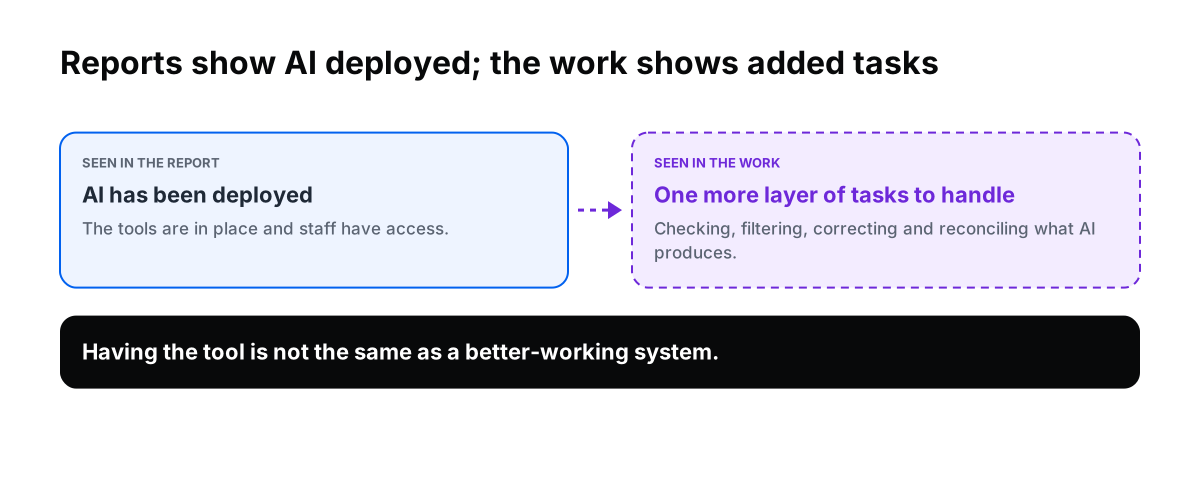
Figure 1. The same reality, seen from the report and from the work.
A recent article in VnExpress — one of Vietnam’s most widely read news outlets — documented a growing pattern of disillusionment among businesses that rushed to adopt AI. Instead of reducing workloads, AI sometimes adds new ones. Instead of improving quality, it produces output that looked polished but contained hard-to-detect errors.
What made the article especially revealing was not the reporting itself, but the hundreds of public comments beneath it. Employees, managers, business owners, and technical professionals shared firsthand accounts of what AI adoption actually looks like inside organizations. Their perspectives were neither uniformly optimistic nor pessimistic — they reflected a nuanced reality that most vendor marketing overlooks.
This analysis draws on both the article and the public discussion to examine a question relevant to any manufacturing SME considering AI: what separates organizations that benefit from AI from those that simply add complexity?
Six Problems That Emerge When AI Is Deployed Too Fast
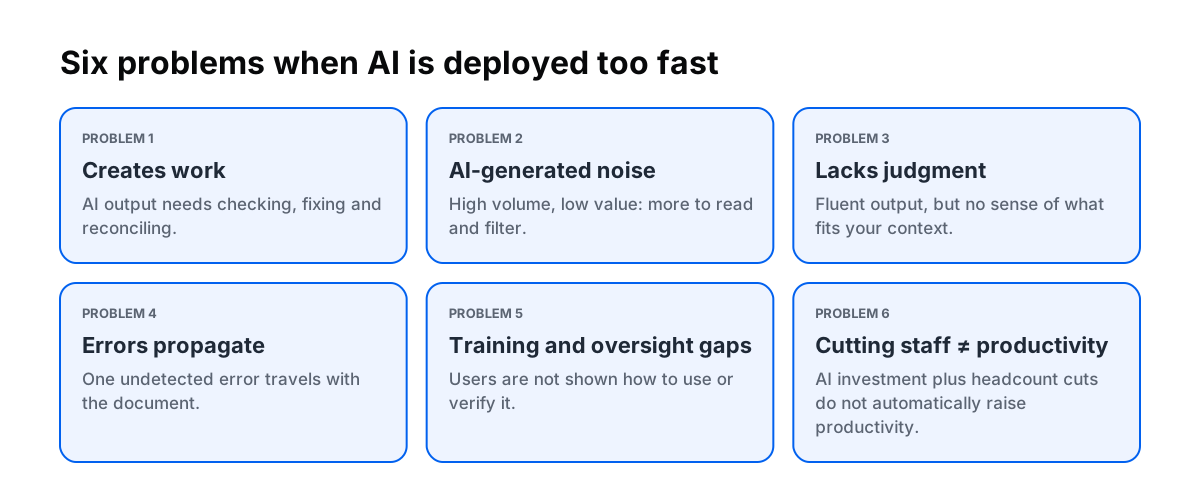
Figure 2. Six problems that emerge when AI is deployed too fast.
1. AI Creates Work Instead of Eliminating It
Employees spend time correcting errors, verifying outputs, and handling false positives. Some AI systems generate recommendations that are technically possible but operationally impractical. Leadership sees “AI deployed.” Frontline staff sees another layer of tasks.
2. AI-Generated Noise Degrades Information Quality
AI produces content quickly. Other AI tools summarize that content. The cycle can generate a growing volume of documents that add no new insight or value. The result is more output, not better output — and often worse, because recipients must now spend additional time distinguishing substance from filler.
3. AI Cannot Replace Experience-Based Judgment
AI processes data fast, but it struggles to recognize anomalies from practical experience, understand product-specific context, or build trust with partners and clients. These capabilities accumulate over years of work and cannot be substituted by a language model, regardless of its sophistication.
4. Errors Propagate Through the Entire Process
AI output can appear convincing while containing subtle mistakes. When that output becomes the input for planning, decision-making, or reporting, initial errors are amplified rather than caught. This is a particularly dangerous risk in manufacturing and compliance-driven industries.
5. Training and Oversight Gaps
Employees are asked to use AI without adequate guidance. At the same time, many organizations lack mechanisms for verifying AI results, approval workflows, or clear accountability when AI makes mistakes.
6. AI Investment Plus Headcount Reduction Does Not Equal Productivity
Some companies have had to restrict AI tools, tighten security protocols, and revisit staffing decisions after realizing that fewer people does not mean greater efficiency — especially when the people removed were the ones carrying critical operational knowledge.
What Actual Users Are Saying: Six Perspectives from Public Discussion
The comments section of the public discussion reveals a far richer debate than simple pro-versus-anti AI sentiment. Six distinct perspectives stand out.
Group 1 — Pragmatic AI Users: “It Helps Me Do My Job Better”
Commenters reported that AI saves them time for drafting, research, information synthesis, and repetitive tasks. Their common thread: they define specific problems for AI to assist with, and they treat it as a tool, not a replacement.
Group 2 — Recipients of AI Noise: “I’m Dealing with the Consequences”
Many described encountering formulaic, shallow content at an increasing rate. They are not opposed to the technology. They are opposed to a rising volume of output with no corresponding rise in value. The paradox: the content creator may save 30 minutes, but multiple downstream readers each spend extra time verifying whether the output is trustworthy.
Group 3 — Domain Experts: “AI Needs Supervision”
Experts emphasized that AI can assist well but cannot replace critical thinking, professional expertise, or peer discussion. Their concern: AI delivers wrong answers with high confidence, and produces work that appears complete but lacks genuine understanding.
Group 4 — Process-Focused Critics: “The Fault Is in the Deployment”
Many argued that results depend on the question asked, the data provided, and the user’s ability. The metaphor “AI is just a shovel” captures this well: a good tool cannot fully compensate for an unskilled user or an organization without clear processes.
Group 5 — Skeptics of Corporate Motives: “AI Is an Excuse to Cut Staff”
Many questioned whether companies are using AI primarily as a justification for headcount reduction. A notable concern: experienced employees are being removed before organizations realize that it is precisely their knowledge and judgment that makes AI useful.
Group 6 — Long-Term Thinkers: “Information Quality Is Declining”
Many predicted that users may eventually grow tired of AI-generated content and seek work with a human signature. This group questions not just whether AI can perform tasks, but what happens to trust and information quality when AI is deployed at scale.
Three Layers of the Problem
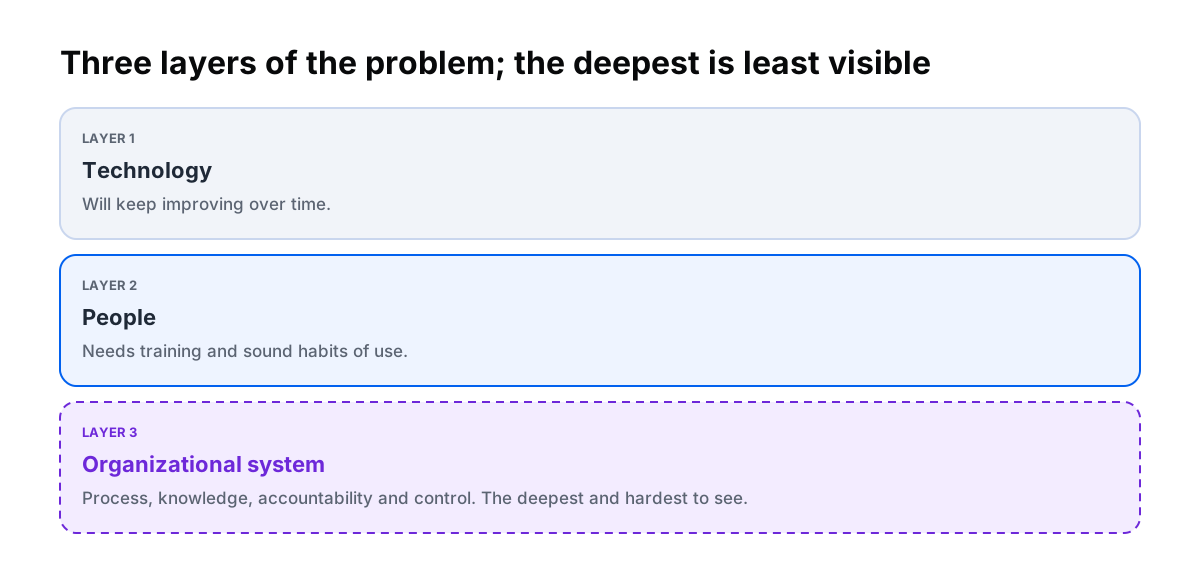
Figure 3. Three layers of the AI adoption problem.
Viewed through a management lens, both the article and the discussion reveal three distinct layers.
Layer 1 — Technology. AI can produce errors, behave inconsistently, or generate outputs that are difficult to verify. This is a technical limitation that will gradually improve.
Layer 2 — People. Employees lack the skills, training, and critical judgment needed to evaluate AI output effectively. This is a capability gap that can be addressed in the medium term.
Layer 3 — Organizational Systems. Processes, data structures, control mechanisms, and accountability frameworks have not been designed for AI to operate within. This is the deepest and most difficult layer to address.
Layer 3 deserves particular attention. AI cannot fix a work system that already lacks coherence, standardization, and oversight. Deploying AI into such a system does not solve the problem — it automates the disorder and may cause it to propagate faster.
The Productivity Paradox: Optimizing a Step, Damaging the System
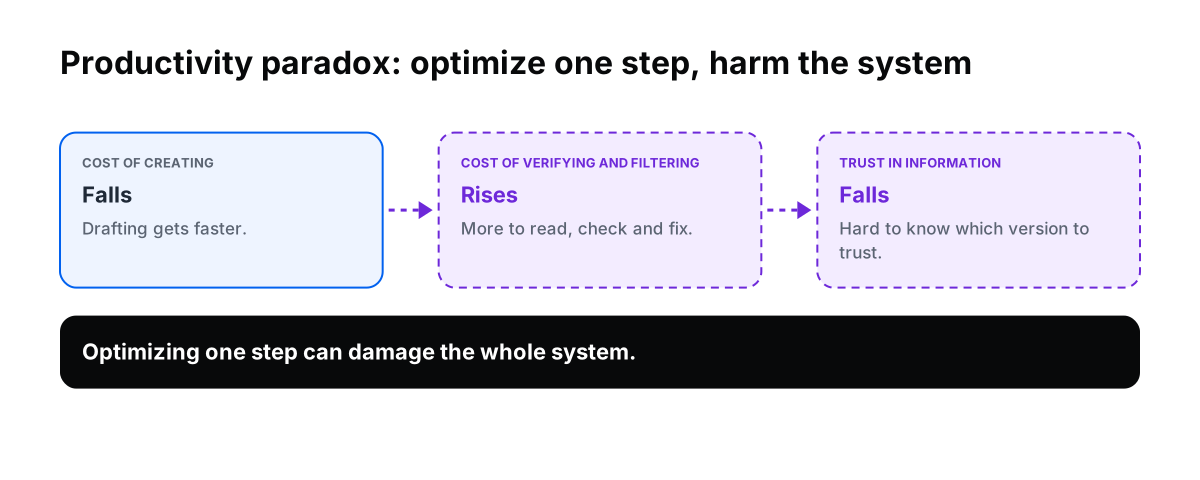
Figure 4. The productivity paradox (qualitative illustration, no data).
The “AI noise” complaints reflect an economic pattern worth examining carefully.
Before AI, producing a report or analysis required significant time, so production cost naturally limited quantity. When AI dramatically reduces the cost of creating content, volume can grow faster than the capacity to verify and absorb it.
The consequences:
- Production costs decrease.
- Verification, filtering, and selection costs increase.
- Benefits to the content creator do not necessarily correspond to benefits for the recipient.
- Trust in information declines if people consistently encounter low-quality output.
This is the productivity paradox in action: optimizing one step can increase the total cost of the entire system. An employee who writes three times faster with AI does not mean the department can handle three times the workload — if every output requires additional verification by someone else.
Organizational Knowledge: What AI Needs But Companies Risk Losing
One of the most thought-provoking threads in the public comments concerns the relationship between AI and organizational knowledge.
Organizations need the knowledge of experienced employees to guide AI, verify results, and handle exceptions. This knowledge is not just in documents. It includes practical experience, contextual understanding, the ability to recognize anomalies, and evaluation criteria that have never been formally written down.
But organizations expect AI to replace those same people in order to reduce costs. If employees leave before their knowledge is captured and transferred, the organization may lose both domain expertise and the ability to oversee AI effectively.
This is not merely an HR issue. It is a knowledge management problem — and it illustrates why AI readiness cannot be measured simply by the number of AI tools deployed.
Not Adopting AI Is Also a Risk — But Adopting AI Does Not Mean Being Ready
Some commenters argued that failing to adopt AI is even more dangerous than adopting it imperfectly. This perspective has merit: organizations that remain entirely outside technological change may lose competitiveness over time.
But the decision is not a binary choice between “use AI” and “don’t use AI.” The real questions are:
- Which tasks genuinely benefit from AI?
- What conditions must be met before deployment?
- Which outputs require human approval?
- When AI makes a mistake, who detects it, who is accountable, and how does the system recover?
- Do the benefits hold up when verification, correction, training, and operational costs are included?
This reframes the debate from belief or fear into manageable, assessable organizational capability.
Intentional Use vs. Uncontrolled Use
The public comments suggest meaningful differences between two approaches to AI. This is a qualitative categorization drawn from public discussion, not a survey result.
| Dimension | Intentional Use | Uncontrolled Use |
|---|---|---|
| Objective | Solve a specific problem | Use AI because everyone is using it |
| AI’s role | Assistant that augments capability | Complete replacement for human work |
| Input | Clear context, domain knowledge, defined requirements | Generic prompts, fragmented data |
| Output | Draft or option for further evaluation | Final product accepted without review |
| Verification | Cross-checked against data, expertise, reality | Trusted because the answer sounds fluent |
| Effectiveness measure | Quality and outcomes across the full process | Speed or volume of content produced |
However, good prompts and skilled users are necessary but not sufficient. AI also requires reliable data, evidence retrieval capability, control mechanisms, and error-handling processes. Neither all failures should be attributed to users, nor all errors treated as inherent flaws of the technology.
Five Dimensions of AI Readiness
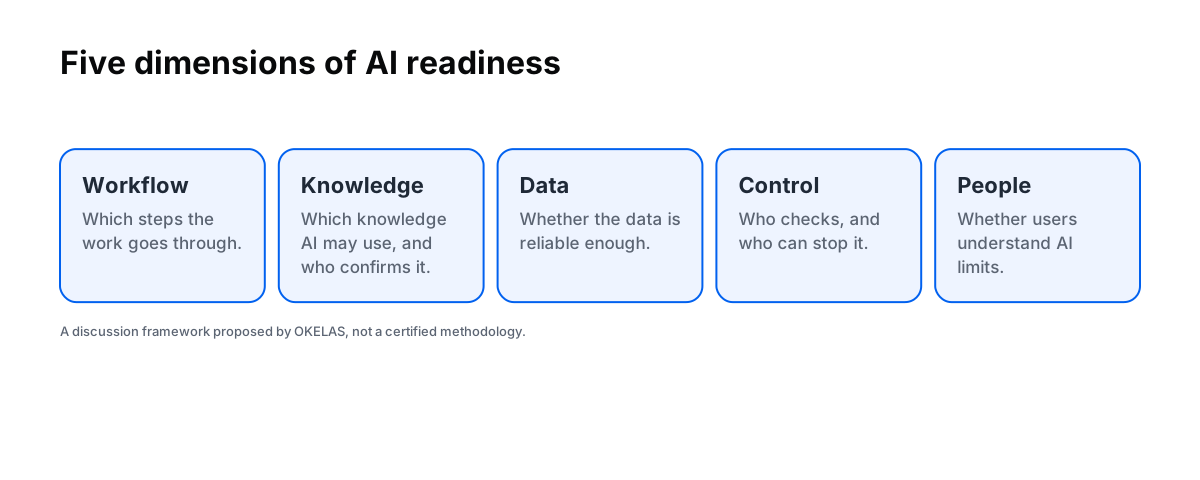
Figure 5. The five dimensions of AI readiness.
Drawing from the issues raised by both the article and public discussion, five evaluation questions emerge. These form a directional assessment framework, not empirically validated criteria.
1. Workflow Readiness
Are processes clear enough to determine where AI should participate? Or is the organization deploying AI into workflows that even humans have not formally described?
2. Knowledge Readiness
Is the necessary knowledge — SOPs, exception-handling experience, evaluation criteria — documented and organized? Or does it exist only in the minds of a few key employees?
3. Data Readiness
Does AI receive data that is relevant, reliable, and properly scoped? Or is it consuming fragmented data from inconsistent sources?
4. Control Readiness
Are there mechanisms for verifying AI output, tracing evidence, approving results, and handling exceptions? Or are AI results accepted by default because they appear convincing?
5. People Readiness
Do employees and managers have the capability to use, supervise, and take responsibility for AI output? Or are they required to use AI without adequate training?
If an organization answers “not yet” to three of the five questions above, the problem may not be which AI tool to choose — but whether the organization is ready for AI at all.
Conclusion: AI Can Accelerate, But Only a Well-Designed Organization Turns Speed into Value
The article and the hundreds of comments beneath it do not say AI is useless. They say there is a gap — sometimes a very large one — between AI’s ability to produce output and an organization’s ability to turn that output into real value.
Experienced users know what AI should do, what it should not do, and which results require verification. Organizations that adopt AI as a trend rather than a capability are prone to confusing volume with productivity, speed with effectiveness, and the ability to generate content with the ability to generate knowledge.
The lesson is not to wait until AI is perfect. The lesson is to build organizational capability — processes, knowledge structures, controls, people — so that AI can be deployed with oversight, rather than allowed to amplify the problems an organization already has.
AI can make a single step faster. But only a well-designed organization can turn that speed into real productivity.
Analysis based on public discussions of AI adoption experiences in organizations. Opinions are analyzed from an organizational management perspective.
Read next:
- What Is AI Readiness — Six Conditions for AI to Actually Work in Operations
- The Difference Between AI Productivity and Organizational Intelligence
- When Key Employees Leave, What Do They Take with Them?
Self-assessment: → Is your organization ready for AI? Take the AI Readiness Assessment
Does this describe your organization?
Does this sound familiar to your organization?